
By: Shahzad Bashir Posted on 2 hours ago
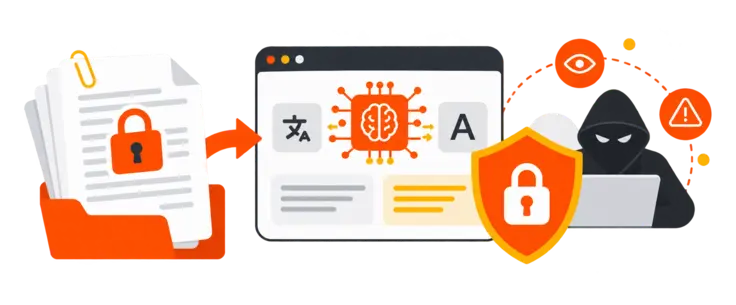
Usually, no. Free AI translators are designed for convenience, not confidentiality. Depending on the tool and its terms, the text you paste may be stored, logged, reviewed by staff, or used to improve the service. For contracts, medical records, financial statements, or anything covered by an NDA, you need a translation option with clear contractual data protections.
This guide explains what actually happens to your text, which risks matter most, and how to translate sensitive documents without creating a data breach.
Imagine a legal assistant with a 40-page supplier contract due in Spanish by morning. A free AI translator is one browser tab away. Paste, click, done in seconds.
The translation may even look excellent. But the contract has now left the company’s controlled environment and landed on servers owned by a third party, under terms the assistant never read. That single copy-and-paste may violate an NDA, a client agreement, or a data protection law.
As AI translation quality has improved, this habit has become common. Speed makes it tempting. The risk is invisible until something goes wrong.
When you paste text into an online translator, it travels to the provider’s servers, is processed by a machine translation model, and the result is sent back. Three questions determine how safe that process is:
Answers vary by provider and by plan. Many consumer-grade tools reserve broad rights to use submitted content to operate and improve their services. Paid and enterprise tiers, by contrast, often promise not to store submissions or use them for training. For example, DeepL has publicly distinguished its paid Pro plans, which it says do not retain texts, from its free version, which may handle data differently. Terms change, so always read the provider’s current privacy policy and terms of service before submitting anything sensitive.
The key point: “free” usually means the data policy is less protective than the paid one. Free users also have no individual contract, so there is little recourse if something goes wrong.
If a tool retains submissions, your confidential text could sit in logs, backups, or training datasets long after you close the tab. You usually cannot verify deletion or request it in a meaningful way.
Most NDAs and client contracts restrict disclosure to third parties. Submitting a client’s document to a public AI tool can count as unauthorized disclosure, even if nobody ever reads it. Many companies now explicitly ban this in their security policies.
Regulations place strict duties on personal and health data:
Free consumer tools typically do not offer the data processing agreements these frameworks expect.
Confidentiality is not the only issue. AI engines can mistranslate negations, drop clauses, mix up dates and numbers, or render legal terms inaccurately, often while sounding fluent. In a contract, patent, or clinical document, one wrong word can change liability, dosage, or meaning. Without a qualified human reviewer, nobody is accountable for the result.
Regulated industries must show who handled a document and how. A free tool gives you no signed confidentiality commitments, no access controls, and no records you can show an auditor.
In 2023, news outlets reported that Samsung employees had pasted internal source code and meeting notes into ChatGPT, after which the company restricted staff use of generative AI tools. That case involved a chatbot rather than a translator, but the mechanism is identical: sensitive text pasted into a public AI service leaves your control. Translation tools carry the same exposure, and translators are often used for exactly the kind of documents companies protect most.
If a leak of the document would cause legal, financial, or reputational harm, treat it as confidential.
| Option | Data protection | Human review | Best for |
|---|---|---|---|
| Free AI translator | Often limited; terms may allow storage or reuse | None | Public, non-sensitive text |
| Paid AI / API plan | Stronger terms, often no training on your data | None | Internal drafts after legal approval |
| Professional translation provider with NDA | Contractual confidentiality, controlled access | Yes, by qualified linguists | Contracts, legal, medical, financial |
If you cannot answer these questions, do not submit the document.
Free tools are perfectly reasonable for low-risk tasks: understanding a public web page, reading a foreign menu, translating a casual email, or getting the gist of marketing copy that is already published. The rule is simple: if you would be comfortable posting the text publicly, a free tool is acceptable.
A reputable language service provider addresses each risk above. At Mars Translation, we work with this in mind:
Every organization’s requirements differ, so ask any provider, including us, for its security documentation and sample NDA before sending a file.
The free consumer version is not designed for confidential material. Its terms let Google process submitted content to provide and improve its services. Businesses needing stronger guarantees should look at paid cloud translation services with a data processing agreement, or a professional provider under an NDA.
DeepL has said its paid Pro plans do not store texts or use them for training, while its free version may be treated differently. Policies change, so check DeepL’s current terms before submitting sensitive text.
Yes, if the provider acts as a processor under a proper data processing agreement, applies appropriate safeguards, and handles international transfers lawfully. Free tools rarely meet these conditions for business use.
It can be. If your NDA restricts sharing information with third parties, submitting the document to a public tool may count as disclosure. Check the agreement or ask your legal team first.
Use a professional translation provider that signs an NDA, holds recognized security certifications, restricts access to authorized staff, and uses qualified human reviewers.
Mars Translation provides confidential document translation in 230+ languages, handled by ISO-certified processes and qualified native linguists. Get an instant quote or place your order, and tell us about any NDA or compliance requirements upfront.
Disclaimer: This article is for general information and is not legal advice. Consult a qualified legal or data protection professional about your specific obligations.
Global businesses translate more content today than ever before, and most of them now face the same decision: should this
Read more
AI translation engines can move through thousands of words in the time it takes to read this sentence. That speed
Read more
AIPE and MTPE are, in most cases, the same service under two names. Both mean a machine or AI system
Read more
Choosing a legal or patent translation provider is closer to hiring outside counsel than to buying a commodity service. The
Read more
What is Oceania? Oceania is a region that includes Australasia, Melanesia, Micronesia, and Polynesia. Oceania covers a land area of 8,525,989
Read more
Everyone knows that learning a language is not an easy task. It takes time and effort to learn any language
Read more
You are moving at the age of development and progress in the medical field. You need to know how you
Read more
There are many instances when a person is required to translate his birth certificates into other language when he is
Read more
It’s your right to stay happy and live a life with complete health. But for this, you need to take
Read more





MarsTranslation is an ISO-certified translation services provider that helps the world's leading brands transform their content in 230+ languages. Get Localization, Interpretation, Proofreading and more.
© Copyright 2026 MarsTranslation



 简体中文