
By: Shahzad Bashir Posted on Tue, 01-09-2026
AI translation engines can move through thousands of words in the time it takes to read this sentence. That speed is genuinely useful, but speed alone has never been the hard part of translation. The hard part is making sure word 10,000 is as accurate, on-brand, and consistent as word one. That's not something an AI engine manages on its own. It's something a person has to own.
That's the entire idea behind managed AI translation AI engines do the translating, and a dedicated project manager manages everything around it so the output is fast and reliable, not just fast.
It's worth being precise about what an AI translation engine actually does. Given a source sentence, it produces a target-language sentence. It does this extremely well and it does it fast. What it doesn't do on its own is remember that your brand name was translated a specific way in a document from six weeks ago, catch that a technical term drifted between two files, or make a judgment call about which of three equally "correct" translations actually fits your brand voice.
That's not a flaw in the technology it's just outside the scope of what a translation engine is built to do. Those are process problems, not translation problems. And process problems need a process, with someone accountable for running it.
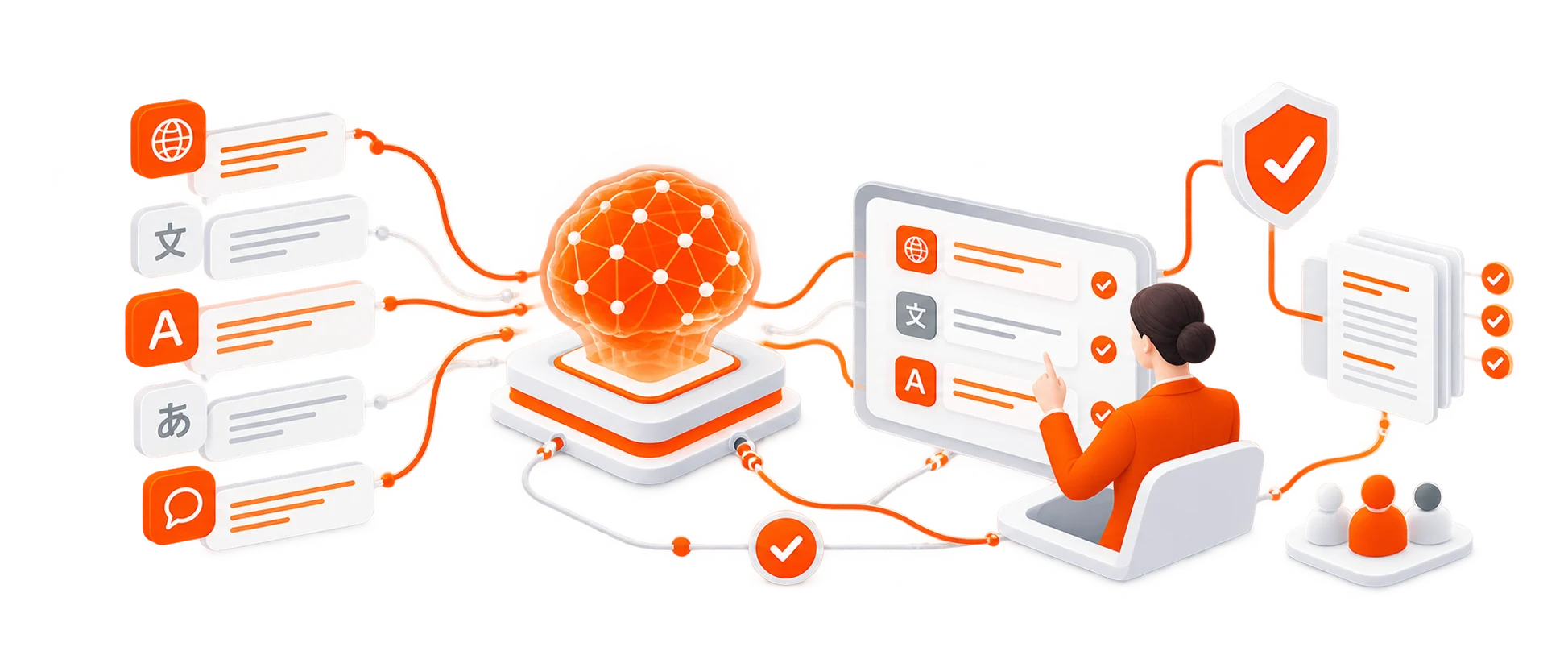
Managed AI translation means every project runs through a defined sequence of steps, with a dedicated project manager (PM) overseeing each handoff, not just reviewing the final file at the end. In a well-run managed workflow, that typically looks like:
1. Glossary of Record: Content that's already been translated and approved gets matched automatically. This keeps previously approved language consistent and means you're not paying to re-translate or accidentally reword sentences that were already signed off.
2. Translation Memory Matching: Before a single sentence is translated, the PM builds and locks a glossary brand terms, product names, industry-specific vocabulary confirmed up front so the AI engine has clear terminology to work from instead of guessing.
3. Ai Translation, Routed Intelligently: Before a human looks at anything, an automated QA layer checks the AI output against the glossary and source content, flagging formatting issues, terminology drift, and anomalies that need a human decision.
4. Automated Quality Checks: Before a human looks at anything, an automated QA layer checks the AI output against the glossary and source content, flagging formatting issues, terminology drift, and anomalies that need a human decision.
5. PM Review And Sign-off: This is the step that separates managed AI translation from raw machine output. The project manager reviews everything flagged by QA, makes the final call, and signs off on delivery. They remain the point of contact for the account going forward, not just for this one file.
No step in that sequence runs unattended. That's the actual definition of "managed" a person is accountable for the process from the first term locked to the final file delivered.
It's tempting to think of the PM's role as a final quality check, a person skimming the output before it ships. In a genuinely managed workflow, that undersells what the PM does. The PM is managing quality before translation even starts by locking terminology the AI engine will follow.
They're managing consistency during the project by overseeing translation memory matching so approved language doesn't drift. And they're managing risk after translation by reviewing exactly the content the automated QA layer flagged as uncertain not spot-checking at random but focusing human judgment precisely where it's needed.
This is a meaningfully different model from "AI translation with occasional human review." It's AI translation run by a person who is accountable for the outcome, using automation to make their oversight efficient at volume instead of trying to manually review everything by hand.
Managed AI translation earns its value most clearly in situations where volume makes fully manual review impractical but where consistency still genuinely matters:
If you're evaluating providers, a few direct questions separate genuinely managed services from AI translation with a project manager's name attached to it as a formality:
A provider that can answer these with specifics, not general reassurances, is one that's actually built a managed process, not just described one in marketing copy.
Most of the frustration businesses have with AI translation isn't really about the AI engine itself it's about what happens when nobody is managing what it produces. Here's what tends to go wrong and how a managed workflow addresses each one directly.
Problem: Terminology Drift Across Documents The same product name or technical term gets translated differently depending on the day, the file, or which AI engine handled it.
Solution: A locked glossary of records, confirmed before translation starts, keeps every document pulling from the same approved terminology permanently, not just for one project.
Problem: Inconsistent Brand Voice AI output can be fluent and still sound "off-brand" too formal, too casual, or just generic because the engine has no memory of your brand's tone from one piece of content to the next.
Solution: The PM reviews flagged content against brand and style guidelines, and translation memory reuses approved phrasing so voice stays consistent across every piece of content, not just within a single file.
Problem: Nobody Catches Formatting Or Structural Errors Broken placeholders, mismatched tags, or layout issues in files like JSON, XLSX, or SRT often go unnoticed until they break something downstream.
Solution: An automated QA layer checks output against the source file structure before a human ever sees it, catching formatting breaks that raw AI translation would otherwise ship as-is.
Problem: Nobody is accountable when something goes wrong With a pure AI tool, there's no one to call when a translation turns out to be wrong, just an API response with no ownership behind it.
Solution: A dedicated project manager signs off on every delivery and remains your point of contact going forward, so there's always a named person accountable for the result.
Problem: Re-translating content that's already been approved Without a system to track what's already been translated and confirmed, teams end up paying to re-translate and sometimes re-word content that was already signed off.
Solution: Translation memory automatically matches and reuses previously approved content, so approved language stays locked, and you're not paying twice for the same sentence.
Problem: Data security is unclear Free or generic AI translation tools often don't disclose what happens to submitted content, whether it's stored, cached, or used to train other models.
Solution: Managed AI translation providers typically process content on private, enterprise-licensed infrastructure with a documented zero-data-retention policy.
| Pure AI / MT Tools | Managed AI Translation | Traditional Agency | |
|---|---|---|---|
| Pricing | Lowest cost, often free or near-free | Efficient priced for volume, without full agency overhead | Highest cost, scales linearly with word count. |
| Turnaround Time | Fastest near-instant | Fast AI speed with PM review layered in | Slowest limited by human translator capacity |
| Terminology Consistency | Unreliable, drifts across documents | Guaranteed, locked glossary maintained by a PM | Strong, but slower to scale across large volumes |
| Human Oversight | None | Dedicated PM on every project | Full human translation and editing |
| Best For | Low-stakes, disposable content | High-volume content that still has to be accurate | Small volume, maximum nuance |
The takeaway isn't that one option is universally "best" it's that managed AI translation is built specifically for the gap between the other two content too high-volume for a fully manual pipeline but too important to leave unsupervised.
AI translation engines are a genuinely powerful tool fast, increasingly fluent, and capable of handling volume no human team could match. But a tool isn't a process, and speed without oversight tends to produce drift that's invisible until a customer, a partner, or a reviewer catches it.
Managed AI translation closes that gap by putting a dedicated project manager in charge of the entire workflow, locking terminology before translation starts, matching approved content automatically, and reviewing exactly what needs a human decision before anything ships. The result is translation that's fast because of AI and accurate because of the person managing it.
AI translation is the raw output of a machine translation engine. Managed AI translation wraps that output in a defined process locked terminology, translation memory, automated QA, and a dedicated project manager who reviews flagged content and signs off on delivery so the result is consistent and accountable, not just fast.
Not entirely a project manager (often with translation and localization expertise) remains actively involved in every project, reviewing flagged content and managing terminology, rather than the process running fully unattended.
It's particularly well-suited to them. Locked glossaries and translation memory become more valuable the longer a project runs, since consistency compounds across an increasingly large body of translated content.
Global businesses translate more content today than ever before, and most of them now face the same decision: should this
Read more
AIPE and MTPE are, in most cases, the same service under two names. Both mean a machine or AI system
Read more
Choosing a legal or patent translation provider is closer to hiring outside counsel than to buying a commodity service. The
Read more
What is Oceania? Oceania is a region that includes Australasia, Melanesia, Micronesia, and Polynesia. Oceania covers a land area of 8,525,989
Read more
Everyone knows that learning a language is not an easy task. It takes time and effort to learn any language
Read more
You are moving at the age of development and progress in the medical field. You need to know how you
Read more
There are many instances when a person is required to translate his birth certificates into other language when he is
Read more
It’s your right to stay happy and live a life with complete health. But for this, you need to take
Read more
China is a popular country for its traditions, customs, and rituals. Being one of the most majestic lands with colorful
Read more





MarsTranslation is an ISO-certified translation services provider that helps the world's leading brands transform their content in 230+ languages. Get Localization, Interpretation, Proofreading and more.
© Copyright 2026 MarsTranslation



 简体中文
简体中文