
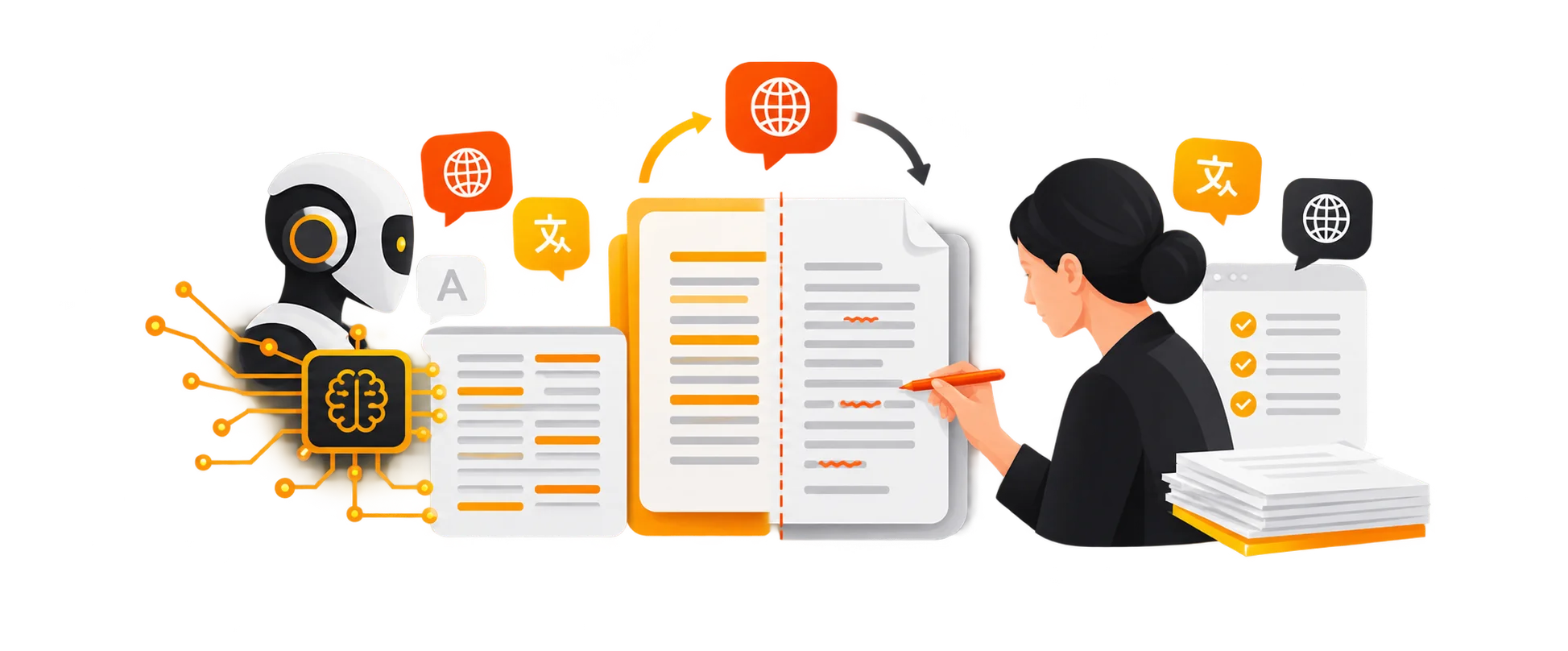
AIPE and MTPE are, in most cases, the same service under two names. Both mean a machine or AI system produces a draft translation and a human linguist corrects it. The choice that actually affects your budget and your brand is not the label. It is how much human work each type of content needs: none, a light edit, a full edit, or a translation from scratch.
This guide explains where the two terms come from, the one question that can change what you are buying, and how to match each kind of content to the right level.
MTPE stands for machine translation post-editing. It is the established industry term for reviewing and correcting machine-translated text. AIPE stands for AI post-editing. It has started appearing on purchase orders and vendor menus as AI translation tools became familiar to people outside the language industry.
| Term | Stands for | Who uses it | What it usually means |
|---|---|---|---|
| MTPE | Machine translation post-editing | Language service providers, translators | A human corrects machine-translated output |
| AIPE | AI post-editing | Buyers, some vendors | The same thing, with the AI element emphasized |
If your order says AIPE and your invoice says MTPE, you have probably not been sold two different things. The workflow is the same: a draft from a translation engine or large language model, then human review.
There is one situation where the labels can mean different things. Some vendors use "AI post-editing" to describe a workflow where a second AI model, not a person, does the editing. The research literature calls this automatic post-editing, or APE.
Automatic editing can be useful for internal or low-risk material. But it removes the human quality gate, and that changes the risk completely. Automated editors can also over-edit, rewriting correct sentences and introducing new errors.
So before you approve any order labelled AIPE, ask one thing:
For anything customers, partners, regulators or search engines will read, the answer should be a human. If you want to understand how automatic editing and automated quality scoring fit into a modern workflow, our guide to automatic post-editing vs automated quality estimation covers it in detail.
Once you know a human is involved, the real decision is the level of human effort. There are four.
| Level | Who does what | Quality target | Best for |
|---|---|---|---|
| Raw machine output | Machine only | Understandable, unpredictable | Gisting, internal research |
| Light post-editing | Machine drafts, human fixes serious errors | Accurate and readable | Technical, high-volume, short-shelf-life content |
| Full post-editing | Machine drafts, human revises for accuracy, terminology and style | Comparable to human translation | Customer-facing content at scale |
| Human translation | Human translates from the source, then a second linguist reviews | Highest, with full accountability | High-risk, creative or certified content |
Light post-editing corrects mistranslations, missing content and clear errors so the text is accurate and easy to understand. It does not polish style. We use it mainly for technical content where readability matters more than elegance.
Full post-editing goes further. It checks terminology, tone and fluency so the result reads as if a translator wrote it. We use it for content that carries your brand, such as marketing materials and website copy, where native reviewers also pay attention to cultural nuance.
You can read how we run each level on our pages for machine translation post-editing and full post-editing.
Content type is the biggest factor in choosing a level, because it sets what happens if something goes wrong. Use this matrix as a starting point.
| Content type | Risk if wrong | Recommended level | Why |
|---|---|---|---|
| Internal memos, meeting notes | Low | Raw or light | Staff only need to understand the meaning |
| Support tickets, chat logs | Low to medium | Light | Speed matters and shelf life is short |
| User reviews (for analysis) | Low | Raw or light | Used for insight, not published |
| Help center and knowledge base articles | Medium | Light or full | Clarity is critical, style less so |
| Technical manuals and specifications | Medium to high | Light or full | Consistent terminology and accuracy matter |
| Software UI strings | Medium to high | Full | Short strings, space limits and tone matter |
| E-commerce product listings | Medium | Light for specs, full for descriptions | Facts must be right, selling copy must persuade |
| Website pages | Medium to high | Full | Public, brand-defining and read by search engines |
| Marketing campaigns and slogans | High | Full post-editing with transcreation, or human | Cultural fit is the product |
| Legal contracts, filings | Very high | Human translation | Errors have legal consequences |
| Medical and clinical content | Very high | Human translation, specialist review | Errors can affect safety |
| Certified translations | Required human | Human translation | A certification needs a human professional |
A few notes on reading this table.
Sort content into buckets, not documents. A single product page may contain specifications (light editing is often enough) and a hero headline (needs a human touch). Splitting content by type inside a project usually saves more than picking one level for everything.
"Recommended" is a default, not a rule. Regulated industries, a public launch or a sensitive audience can push any row up a level.
Machine translation quality varies a lot by language. For widely supported pairs with clean source text, the draft is often strong and editing is faster. For lower-resource languages, the draft can be weak enough that a post-editor is effectively rewriting it. In that case the savings narrow, and human translation may give you a better result for a similar cost.
Ask your provider whether the engine they plan to use has been checked on your specific language pair and content type.
Post-editing works best on clear, consistent source text. Ambiguous sentences, inconsistent terminology and slang all produce weaker drafts and more editing work. If your source is messy, pre-editing can reduce errors before they occur and lower the editing effort afterwards. A good glossary and translation memory help in the same way.
Ask a simple question: if this sentence is wrong, who is harmed, and how badly? An awkward help article costs a support ticket. A wrong dosage instruction costs far more. The higher the harm, the more human involvement you need, regardless of the price difference.
Here is an illustrative example of how the levels differ. The source sentence is English, and the translation is Spanish.
Source: Press and hold the power button for five seconds to reset the device. Your settings will not be lost.
Presione y sostenga el botón de encendido durante cinco segundos para reiniciar el dispositivo. Sus configuraciones no serán perdidas.
Presione y sostenga el botón de encendido durante cinco segundos para reiniciar el dispositivo. Sus configuraciones no se perderán.
Change: the last sentence was rewritten to fix an unnatural passive construction. Nothing else was touched.
Mantenga pulsado el botón de encendido durante cinco segundos para restablecer el dispositivo. No perderá su configuración.
Changes: the phrasing now matches the wording used across the rest of the manual, uses the more natural verb for holding a button, and addresses the user in the form the brand style guide requires.
The raw output is understandable. The light edit removes the most obvious error. The full edit reads like it was written in Spanish from the start. For a factory manual used by trained technicians, the light version may be enough. For a consumer product guide, the full version is worth it.
Post-editing costs less than translating from scratch, and light post-editing costs less than full. But the label does not set the price. Content difficulty does. A clean, technical English text in a well-supported language will edit quickly. A dense, ambiguous text in a harder language pair will not.
For that reason, be wary of any flat rate quoted without seeing your content. The fair question is not "what is your MTPE rate?" but "how good is the draft you will produce for this content, and how does that affect the effort?"
Our machine translation post-editing services start at the rates listed on our pricing page. You can also use our instant quote tool to estimate your own project.
No. They usually describe the same workflow, so price depends on the level of editing, the language pair and the content, not the label. If a quote for "AIPE" is much lower than an MTPE quote, check whether a human is actually editing.
Technically yes. This is called automatic post-editing. It can work for internal or low-risk content, but it has no human quality gate and can introduce new errors. For published, customer-facing or regulated content, human post-editing is the safer choice.
Usually not for public pages. Light editing fixes errors but does not polish tone or brand voice, which matter on pages that represent your company. Use full post-editing for key pages, and consider light editing for support articles or background content.
Languages with less training data for translation engines tend to produce weaker drafts, so editors have more to fix. Ask your provider how they evaluate quality for your specific language pair before choosing a level.
Ask whether post-editors are native speakers with subject expertise, how terminology is managed, and what quality checks apply. Ask which standards the provider's process follows. At MarsTranslation, projects run under ISO-certified processes and are supervised by subject experts.
How to decide, in short
If you are not sure where your content falls, send us a sample. We will recommend a level for each content type and show you what the output looks like before you order. Request a free quote to get started.

Global businesses translate more content today than ever before, and most of them now face the same decision: should this
Read more
AI translation engines can move through thousands of words in the time it takes to read this sentence. That speed
Read more
Choosing a legal or patent translation provider is closer to hiring outside counsel than to buying a commodity service. The
Read more
What is Oceania? Oceania is a region that includes Australasia, Melanesia, Micronesia, and Polynesia. Oceania covers a land area of 8,525,989
Read more
Everyone knows that learning a language is not an easy task. It takes time and effort to learn any language
Read more
You are moving at the age of development and progress in the medical field. You need to know how you
Read more
There are many instances when a person is required to translate his birth certificates into other language when he is
Read more
It’s your right to stay happy and live a life with complete health. But for this, you need to take
Read more
China is a popular country for its traditions, customs, and rituals. Being one of the most majestic lands with colorful
Read more




MarsTranslation is an ISO-certified translation services provider that helps the world's leading brands transform their content in 230+ languages. Get Localization, Interpretation, Proofreading and more.
© Copyright 2026 MarsTranslation



 简体中文
简体中文